
College admissions are subjective. At Harvard, the difference between accepted and rejected can be as little as 0.07%.
You can have the perfect application and get rejected.
That’s not what happened to Johnny…
Johnny gave everything he had and then gave more. It feels like a horror story, but it’s really a tragedy.
The tragedy wasn’t the rejection. It’s what he gave up in the name of college admissions.
Johnny did everything he was supposed to, but he didn’t become anyone.
We’re going to tell a story over the next several emails. It’s the story of Johnny, written from several perspectives.
It’s a story of hope.
The conveyor belt rolls on.
The admissions officer, a 25-year-old Taylor Swift fanatic, clicks a button. A new app appears: JOHNNY ATLAS
She has 5 minutes to evaluate Johnny.
No one can be busier than 168 hours a week allows. Johnny isn’t busier or harder working than the other 49 kids that the admissions officer reviews today.
He’s not harder working than the 250 last week, and he won’t be harder than the 250 next week.
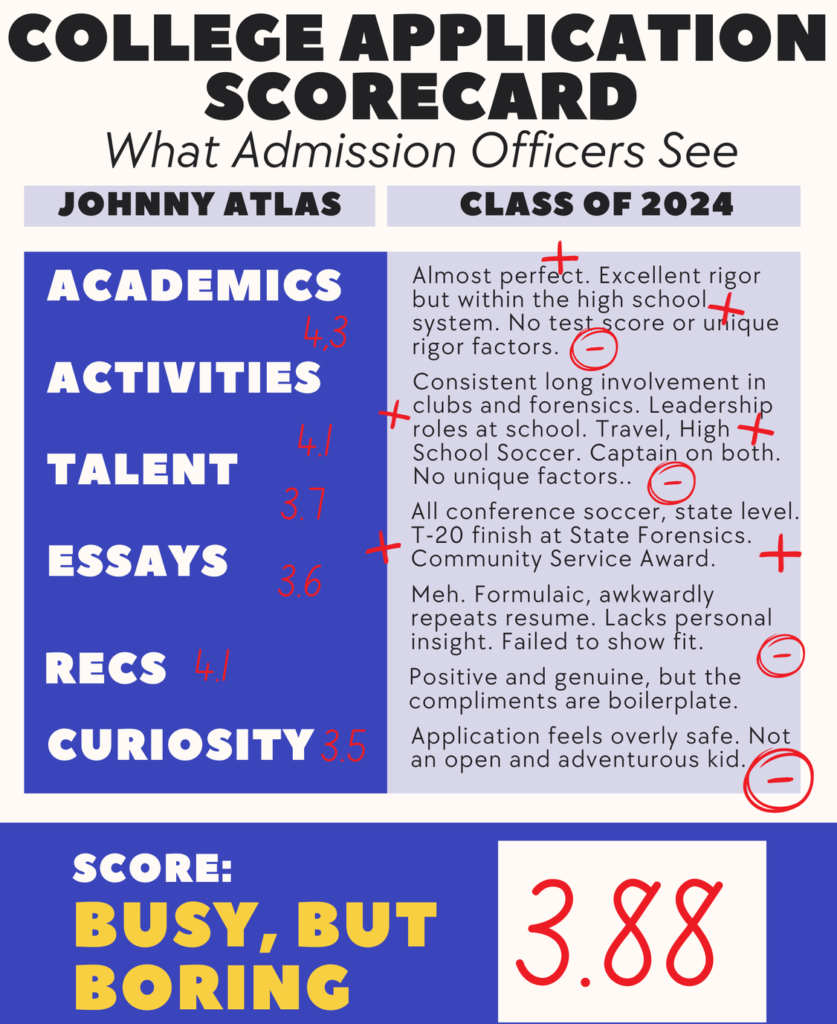
The system calculates a GPA and rigor score, and the transcript is translated to a college-wide standard. The admissions officer doesn’t even see the +’s and—’s that Johnny fretted over. She has no idea that Johnny’s chemistry teacher is an academic thresher and that chemistry is really hard for Johnny.
She also doesn’t see Johnny’s 3s on the Chemistry or US History AP exams. She has no idea that Johnny’s APUSH teacher left in November, and he spent over 200 hours studying independently.
She doesn’t know that Johnny traded his ‘shot’ at a great ACT/SAT score to get two unreported 3s.
Clearly, Johnny is good at soccer, and it’s good that he’s captain, but he won’t play for the college. The admissions officer has no clue what Platinum Cup means. And it seems like every high school athlete plays travel.
Leadership in Student Council and Interact Club are titles, but Johnny doesn’t show them any impact.
Johnny volunteered a lot, mainly through the NHS. But signing up and going just means attendance.
Johnny founded an Autism Club. That could be interesting, but Johnny didn’t really do anything with it. Johnny’s essay hinged on his autistic cousin. The admissions officer finds the combination…convenient.
Ask the admissions officer, and she’d almost certainly say, “Great kid, I’m sure.” Johnny Atlas is exceptional at his school, but there are 27,714 high schools in the US.
The admissions officer feels no guilt, but there’s no real shot for Johnny.
Every day brings a queue of 50 applications. Most read like Johnny’s; the admissions officer drowns in his own sea of leaders, club founders, and achievers.
The differences are subtle and subjective. Five minutes after opening Johnny’s app, the admissions officer clicks Next.
“7 more apps until lunch…”
You don’t apply to a college. You apply to an admissions office.
I said it at the top, and I’ll repeat it. You can do everything right and still get rejected.
Maybe you were a whisper away. Maybe the first-round admissions officer got dumped by text that morning. Maybe the pool you competed against was especially tough. Maybe you lost in the “horse trading” of admissions committees. Maybe it was about the college’s yield.
But Johnny’s chances were killed by busyness. That linear, straight shot to the top left him with awards and titles but no story and nothing to say about himself.
Johnny’s admissions officer wants to help kids. The horse race takes all of that away. It homogenizes and cheapens great kids on paper and in their souls.
The real lesson of Johnny’s story is the hydrogen bomb of college admissions – authenticity, a person in the process of becoming. It clears away all the sticks and stones and stoplights of high school life.
It’s undeniable when you see it. It’s the difference between the lightning and the lightning bug.
Like all great stories, your application made them feel alive. And that, more than anything, is what they want.

This will close in 0 seconds